

Joint Work Plan
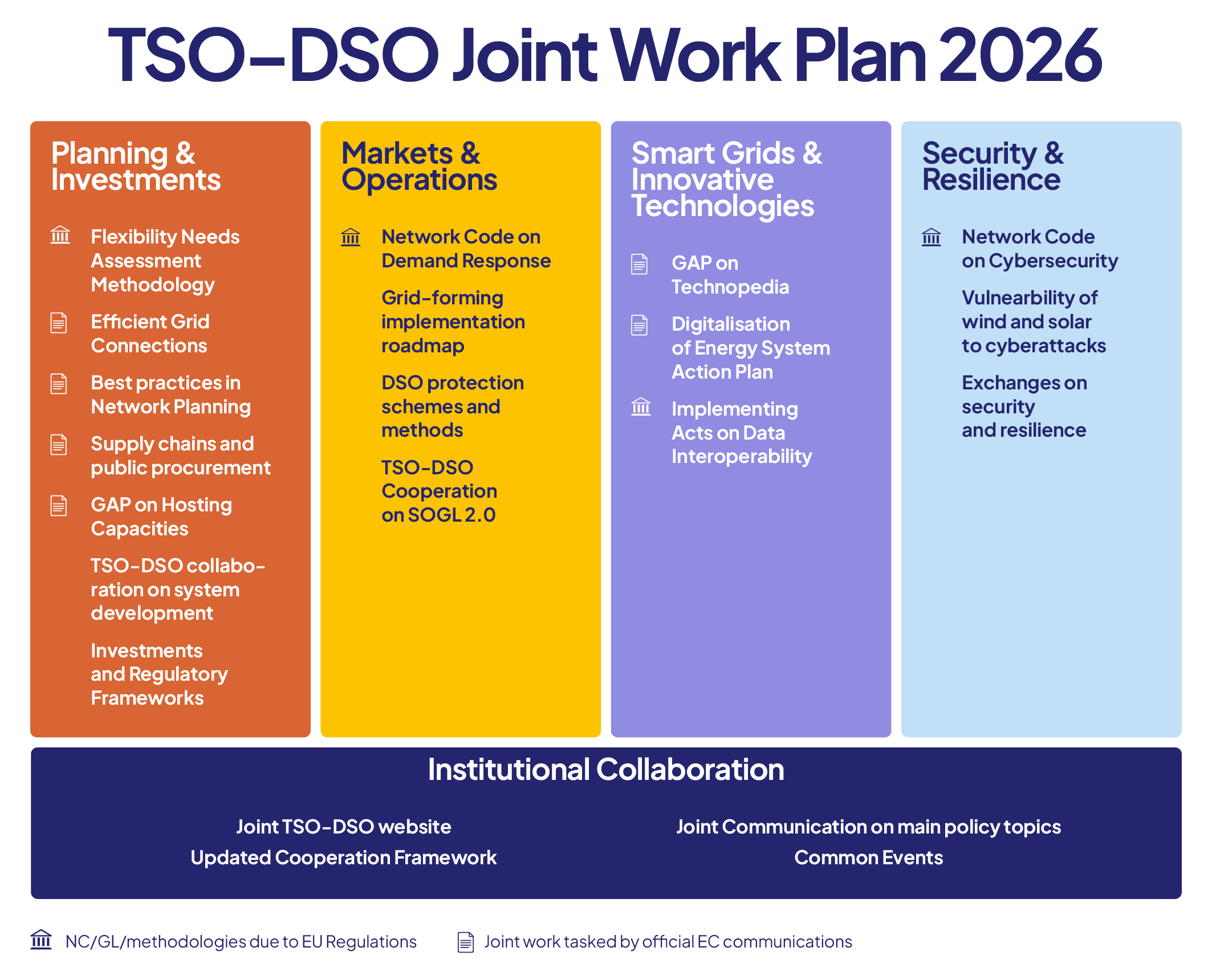
The following activities represent the key areas of joint work assigned to ENTSO-E and DSO Entity through EU legislation, official EC communications, and other formal mandates. They include activities that continue from the 2025 work plan, as well as any new joint mandated activities identified in 2025. Any new activity assigned to the two associations in 2026 will be incorporated into the joint work plan, even if it is not yet reflected in the current list. More detailed descriptions of each activity, including deliverables and implementation milestones, are provided in the Annual Work Programme for 2026 of both associations.
Planning and Investments
As mandated by Article 19e (4) of Regulation (EU) 2019/943, which was introduced by the Electricity Market Design Reform (EMDR) Regulation (EU) 2024/1747, ENTSO-E and the EU DSO Entity were tasked with jointly developing the type and format of data, as well as a methodology for analysing flexibility needs at the national level. To this end, the Associations established a joint task force to prepare the proposal defining the required data formats, types, and analytical approach for flexibility needs assessments (FNAs) by system operators. This proposal was successfully submitted to ACER within the nine-month deadline and formally approved in July 2025, marking the official launch of the FNAs at the Member State level. Going forward, ENTSO-E and the DSO Entity will support TSOs and DSOs during the implementation phase, including by coordinating the data and analysis required for the preparation of national FNA reports in line with the methodology, and by providing guidance on recurring implementation challenges faced by system operators.
Building on the EC’s Guidance on Efficient and Timely Grid Connections (C/2025/6703), part of the European Grids Package, ENTSO-E and the DSO Entity are committed to sharing knowledge, exploring alignment, and engaging in expert-level collaboration through workshops/webinars or a joint study.
EU DSO Entity and ENTSO-E focus on strengthening DSO–TSO collaboration in network planning at the national level. The work aims to identify and document effective approaches to align planning methodologies and coordinate investment priorities. The outcome will support a common understanding and more coordinated planning processes between DSOs and TSOs across Europe.
Building on the joint roadmap towards resilient supply chains, ENTSO-E and the DSO Entity are committed to conducting knowledge-sharing activities and exploring joint positions on topics introduced by the EC’s Communication – An EU Action Plan for Grids (COM/2022/552), Action 13, as well as related areas such as skilled workforce, circular economy, investment visibility, and asset management and implementation.
Under Action 6 of the EC’s Communication – An EU Action Plan for Grids (COM/2022/552), DSO Entity and ENTSO-E are working to establish a pan-European overview of available grid hosting capacities. The general goal of Action 6 is to improve visibility on grid capacity and connection requests, supporting the planning of renewables, storage systems, EV charging stations, and other relevant new project developers. The main deliverable will be the DSO Entity and ENTSO-E Capacitypedia, a common IT platform designed to provide clarity on grid hosting capacity information by describing and explaining commonly used terms and techniques for presenting such information by system operators.
Both TSOs and DSOs face increasing challenges to develop, finance, and build electricity grids and to connect new generation and electricity demand to the grid and transport electricity. TSOs and DSOs can collaborate to share best practices in areas such as financing investments, including accessing EU funding (e.g. CEF-E, the new Competitiveness Fund), loans, and de-risking instruments for financing grids (e.g. guarantees from state organisations, development banks or the EIB, green bonds).
Exchange of information between ENTSO-E and EU DSO Entity on system development methodologies and planning approaches (e.g. IoSN and CBA methodologies).
Markets and Operations
Pursuant to Article 59(9) of Regulation (EU) 2019/943, ENTSO-E and the DSO Entity submitted the NC DR package (including the NC DR, and amendments to the EB Guideline, the System Operation Guideline (SO GL), and the Demand Connection Network Code) on 8 May 2024 to ACER. Following the submission of ACER’s Recommendation No 01/2025 on a reasoned proposal for the establishment of the NC DR in March 2025, ENTSO-E and DSO Entity will monitor and support the adoption process by the EC (currently planned to start in Q1 2026) and carry out planning work to implement the NC DR starting in 2026.
As provided in Article Y(5) of ACER’s Recommendation to amend the Network Code on Requirements for Generators (NC RfG 2.0) , the relevant TSO in coordination with the relevant system operator may specify that type A power park modules shall be capable of providing grid forming capability at the connection point. The Member State or their designated entities may require that the relevant TSO in coordination with the relevant system operator shall specify that type A power park modules shall be capable of providing grid forming capability at the connection point. In this case, the Member State or a designated entity shall develop a roadmap within two years after entry into force of NC RfG 2.0 Regulation in order to assess a roll-out of grid forming capability, that may include impact assessments on oscillations, island mode detection or other technical challenges.
read moreThe new capabilities included in ACER’s CNC 2.0 recommendations may require updates to some DSOs’ protection schemes. TSO–DSO discussions would be beneficial to collect feedback on how DSOs plan to adapt protection schemes to comply with the new requirements, including – but not limited to – the fault ride-through requirement for Type A generators and grid-forming capability.
The goal is to foster an open discussion on new capabilities and known protection issues in distribution systems, with the aim of ensuring system security and stability. This also includes the schemes and methods for anti-islanding detection to address the new capabilities defined in NC RfG 2.0 and NC DC 2.0 (for electric vehicles and Type A power park modules).
The below activities consist of technical exchanges between ENTSO-E and EU DSO Entity on operational topics relevant to the upcoming review of the System Operation Guideline (SOGL).
Increasing Visibility of PV Infeed
TSOs face significant challenges with the PV infeed as there are no direct ways of controlling them, as many PVs are Type A generation units connected to the distribution grid, which are not subjected to observability nor controllability requirements. Thus, this can be promoted as a relevant topic for engagement between ENTSO-E and DSO Entity, including discussions on data exchange of their participation in different services.
read moreSmart Grids and Innovative Technologies
In alignment with the EC’s Communication - Digitalising the energy system – EU action plan (COM/2022/552), ENTSO-E and the EU DSO Entity are actively collaborating through the Joint Task Force for DESAP. This partnership is driving progress on key deliverables, including the recently published Common TSO–DSO Challenges & Opportunities report (February 2025), use cases and digital twin solutions8 (January 2026), a digital twin roadmap (planned in late Q2 2026), and a smart grid indicators framework to measure performance and effectiveness.
This work package promotes the adoption of innovative grid technologies through the continued development of the joint DSO/TSO Technopedia, as requested by Action 7 of the EC’s Communication – An EU Action Plan for Grids (COM/2023/757). Building on the successful launch of the common IT platform in 2025, ENTSO-E and DSO Entity will expand its content and improve its methodology for collecting and reviewing technological solutions relevant to system operators.
In line with the Commission Implementing Regulation (EU) 2023/1162 on interoperability requirements and non-discriminatory and transparent procedures for access to metering and consumption data, ENTSO-E and EU DSO Entity continue their cooperation on data transparency and interoperability within the Joint Working Group (JWG) on data interoperability, established in 2023. The JWG supports and advises the EC in monitoring and further developing the implementing acts on data interoperability in accordance with Article 24(2) of Directive (EU) 2019/944 and Article 12(2) of Implementing Regulation (EU) 2023/1162. This joint work aims to ensure consistent mapping and further development of data interoperability requirements and rules for metering and consumption data, demand response, and customer switching, while also supporting the EC in any additional implementing acts on data interoperability it may deem necessary. DSO Entity and ENTSO-E will also continue to update the JWG Repository, a common IT platform mandated by Article 12(1)(c) of Regulation (EU) 2023/1162 and established in July 2025. The JWG Repository publishes guidance for Member States on mapping national practices for data interoperability, the collected mappings and their version history, and other relevant information supporting European energy service interoperability. This includes, but is not limited to, implementing acts on data interoperability adopted by the EC and data interoperability models.
Go to Electricity Data Interoperability
Security and Resilience
In line with Article 6 (1) of European Commission Delegated Regulation (EU) 2024/1366 (NCCS Regulation), ENTSO-E and DSO Entity will continue their collaboration to develop terms, conditions, and methodologies (TCMs) and other related recommendations foreseen by the NCCS Regulation, and to support their implementation.
The increasing digitalisation and decentralisation of the power grid, driven largely by solar and wind integration, introduce significant cybersecurity vulnerabilities. A growing number of distributed renewable energy assets are connected to DSO grids. TSO–DSO coordination ensures comprehensive risk mitigation across all voltage levels, enhances system-wide resilience, while also promoting coordinated response mechanisms and shared situational awareness across the grid. The activity focuses on the exchange of information and alignment of perspectives between TSOs and DSOs.
The security and resilience of the electricity system are critical for TSO and DSO work plans because they directly impact the reliability and stability of the power supply. As the energy system becomes more decentralised and integrates higher shares of renewable and digital technologies, new challenges emerge, such as increased hybrid threats, variability in generation, and the need for real-time coordination. Incorporating security and resilience into the TSO–DSO work plan ensures that both operators can proactively manage risks, maintain grid reliability, and support the broader goals of the energy transition.